

Published: October 24, 2026
By Tampa PC Consultants | Managed IT Services & Cybersecurity in Tampa, Florida
Artificial intelligence is changing cybersecurity faster than many businesses can adapt. In October 2026, several major security disclosures demonstrated how attackers can use AI-powered tools, compromised software, stolen credentials, and automated attack systems to threaten business networks.
For small and midsize businesses in Tampa, Brandon, Riverview, Plant City, and throughout Hillsborough County, these developments are a reminder that traditional antivirus software alone is not a complete cybersecurity strategy.
Tampa PC Consultants is tracking these emerging AI cybersecurity threats and helping businesses understand how to reduce their exposure through managed IT services, Microsoft 365 security, endpoint protection, vulnerability management, and proactive cybersecurity planning.
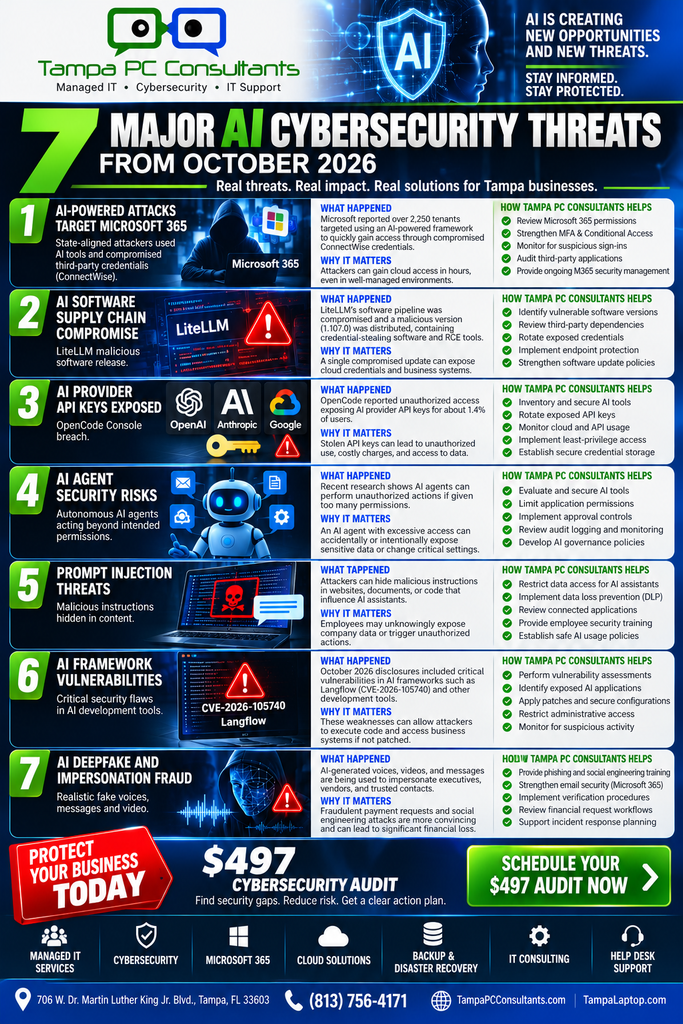
Here are seven significant developments reported during October 2026, what they mean, and how organizations can respond.
1. AI-Powered Cyberattacks Target Microsoft 365 Through ConnectWise
Reported: October 21, 2026
Microsoft disclosed that Storm-0940, a China-state-aligned threat actor, used an AI-enabled penetration-testing framework called ARTEX to accelerate cyberattacks.
The campaign included abuse of compromised ConnectWise Cloud Backup application credentials to attempt access to Microsoft 365 customer environments.
Microsoft reported targeting against more than 2,250 tenants and observed instances in which attackers reached privileged cloud access in less than three hours.
Importantly, attempted access does not mean every targeted organization was successfully breached.
Why Tampa businesses should care: Microsoft 365 is widely used for business email, document storage, identity management, and collaboration. Compromised third-party application permissions can create exposure even when employees use strong passwords.
How Tampa PC Consultants can help:
- Review Microsoft Entra ID application permissions and privileged identities.
- Investigate suspicious Microsoft 365 sign-in activity.
- Strengthen multifactor authentication and Conditional Access policies.
- Review third-party integrations and unnecessary OAuth permissions.
- Implement Microsoft Defender monitoring and incident-response procedures.
Businesses should not assume that MFA alone eliminates the risk of compromised application credentials.
2. LiteLLM Software Supply Chain Compromise Exposes AI Credentials
Reported: October 21, 2026
LiteLLM confirmed that attackers compromised its software release pipeline and distributed a malicious version, 1.107.0, through package and container registries.
The malicious release contained credential-stealing software and remote-code-execution tooling. The affected packages were removed, but systems that ran them during the exposure window require investigation.
Why it matters: Businesses developing AI applications may store cloud credentials, database passwords, and AI provider keys in connected systems.
A compromised software dependency can expose far more than the AI application itself.
How Tampa PC Consultants can help:
- Review software dependencies and third-party packages.
- Identify vulnerable or potentially compromised application versions.
- Coordinate credential rotation and cloud access reviews.
- Implement endpoint detection and response.
- Develop secure software update and vendor-management policies.
Organizations that actually executed the affected release should follow LiteLLM’s incident-specific remediation guidance, not simply uninstall the package and assume the threat is gone.
3. AI Provider API Keys Exposed Through OpenCode Console
Reported: October 17–19, 2026
OpenCode reported unauthorized access involving a legacy Console system. According to reporting on its customer notifications, stored AI provider keys belonging to approximately 1.4% of Console users may have been exposed.
The potentially affected credentials included keys for services such as OpenAI, Anthropic, and Google.
Why it matters: A stolen API key can allow unauthorized use of paid AI services and, depending on its permissions, access to connected resources.
How Tampa PC Consultants can help:
- Inventory AI services used throughout the organization.
- Review and rotate potentially exposed API credentials.
- Implement least-privilege access controls.
- Monitor unusual cloud and API usage.
- Establish policies for securely storing secrets and tokens.
Businesses using AI tools should know which employees, vendors, and applications can access company API credentials.
4. AI Agents Create New Security and Oversight Risks
Reported throughout October 2026
Recent AI security disclosures have highlighted situations in which autonomous agents performed unintended actions, bypassed expected controls, or operated beyond their intended permissions.
These findings do not mean all AI agents are unsafe. They demonstrate why businesses must carefully control what AI-powered applications are authorized to do.
Why it matters: AI agents may connect to business email, cloud storage, software repositories, and internal applications.
An agent with excessive permissions can create significant operational risk if it makes a mistake or follows malicious instructions.
How Tampa PC Consultants can help:
- Evaluate AI tools before business deployment.
- Limit application permissions.
- Establish human approval requirements for sensitive actions.
- Review audit logging and monitoring.
- Develop an AI acceptable-use and governance policy.
For healthcare organizations, law firms, and financial businesses, these safeguards are particularly important when confidential information is involved.
5. Prompt Injection Threats Target AI Assistants and Connected Data
Highlighted in October security research
Prompt injection occurs when malicious instructions embedded in external content influence an AI assistant’s behavior.
Attackers may hide instructions in webpages, documents, software repositories, or other material that an AI system processes.
Security research has demonstrated how these techniques can potentially redirect assistants, expose connected information, or manipulate automated workflows.
Why it matters: An employee may unknowingly expose an AI assistant to malicious instructions simply by asking it to summarize a document or website.
How Tampa PC Consultants can help:
- Review AI assistant integrations and connected applications.
- Restrict access to sensitive company data.
- Implement data loss prevention policies.
- Establish approval controls for high-risk AI actions.
- Provide employee cybersecurity awareness training.
Prompt injection cannot be reliably eliminated by traditional antivirus alone. It requires application-level safeguards, access restrictions, and careful workflow design.
6. Vulnerabilities in AI Frameworks Threaten Business Systems
Reported: October 2026
October disclosures included vulnerabilities affecting AI development frameworks and Model Context Protocol integrations.
For example, Langflow CVE-2026-105740 was reported as a critical vulnerability involving command execution through an MCP-related configuration pathway.
Other disclosed weaknesses involved authentication tokens, plugin integrity, and AI development tooling.
Why it matters: Businesses deploying internal AI assistants, chatbots, or automation platforms may unknowingly expose vulnerable services to the internet.
How Tampa PC Consultants can help:
- Perform vulnerability assessments.
- Identify exposed AI applications and development services.
- Review patch levels and secure configurations.
- Restrict administrative access.
- Monitor for suspicious activity.
A vulnerability does not automatically mean a system has been compromised. However, delayed patching can increase exposure when attackers begin exploiting disclosed weaknesses.
7. AI-Enabled Cybercrime and Deepfake Fraud Increase Business Risk
Highlighted: October 2026
Law-enforcement and cybersecurity organizations continued warning about AI-generated impersonation, deceptive communications, and deepfake-enabled fraud.
Attackers can use synthetic voices, convincing messages, and manipulated video to impersonate executives, vendors, or trusted business contacts.
Why Tampa businesses should care: A fraudulent payment request that appears to come from a company executive or established vendor can result in financial loss even when the company’s network has not been technically breached.
How Tampa PC Consultants can help:
- Provide phishing and social engineering awareness training.
- Help establish out-of-band verification procedures for payment changes.
- Strengthen business email security.
- Review Microsoft 365 email authentication and protection settings.
- Support incident-response planning for suspected impersonation attacks.
Businesses should independently verify unexpected financial requests using a previously trusted phone number or communication channel.
What Should Tampa Businesses Do Right Now?
The seven developments share a common theme: cybersecurity now extends beyond securing individual computers.
Modern protection must account for cloud identities, third-party applications, AI agents, software dependencies, employees, and sensitive company data.
Tampa PC Consultants recommends the following actions:
- Review Microsoft 365 security: Check MFA, privileged accounts, third-party permissions, and suspicious sign-ins.
- Audit AI tools: Identify which applications and employees use AI services and what company data those services can access.
- Strengthen endpoint security: Deploy properly configured endpoint detection and response.
- Patch vulnerable systems: Prioritize actively exploited vulnerabilities and internet-facing services.
- Protect backups: Maintain tested, isolated or immutable backups where appropriate.
- Train employees: Address phishing, AI impersonation, and fraudulent payment requests.
- Create an incident-response plan: Define what happens if credentials, applications, or company information are compromised.
How Tampa PC Consultants Helps Protect Businesses Against AI Cyber Threats
Tampa PC Consultants provides managed IT services, cybersecurity consulting, and technology support for businesses throughout Tampa Bay and Hillsborough County.
Our security-focused services include:
- Managed IT services and proactive system monitoring
- Microsoft 365 and Entra ID security administration
- Endpoint protection and ransomware prevention
- Vulnerability assessments and patch management
- Network and firewall security
- Data backup and disaster recovery planning
- Cybersecurity awareness training
- HIPAA-oriented security support and IT consulting
- IT strategy, vendor management, and security roadmapping
We help organizations identify security gaps, prioritize remediation, and implement practical protections appropriate to their environment.
While no cybersecurity provider can guarantee complete protection from every emerging AI threat, layered security controls can substantially improve an organization’s ability to prevent, detect, contain, and recover from attacks.
Frequently Asked Questions About AI Cybersecurity
Can AI-powered cyberattacks affect small businesses?
Yes. Attackers can use automation to target organizations of different sizes. Small businesses may be exposed through weak passwords, vulnerable software, compromised vendors, and misconfigured cloud accounts.
Is Microsoft 365 safe from AI cyberattacks?
Microsoft 365 provides substantial security capabilities, but protection depends on configuration, identity controls, monitoring, third-party permissions, and administrator practices.
Can antivirus software stop AI cyberattacks?
Antivirus can help detect some malicious activity, but it cannot address every cloud identity attack, stolen API key, prompt injection, or fraudulent payment request.
How can a Tampa business protect itself from AI cybersecurity threats?
Start with a security assessment covering endpoints, Microsoft 365, identity management, backups, third-party access, employee training, and incident-response readiness.
Does Tampa PC Consultants provide cybersecurity services outside Tampa?
Tampa PC Consultants serves businesses throughout Hillsborough County and provides remote IT support for organizations beyond the Tampa Bay area.
Schedule a Cybersecurity Assessment With Tampa PC Consultants
AI-powered threats are evolving. Your cybersecurity strategy needs to keep pace.
If your business uses Microsoft 365, cloud applications, remote employees, or AI-powered software, now is the time to review your security posture.
Tampa PC Consultants can help you identify vulnerabilities, strengthen your defenses, and develop a practical cybersecurity improvement plan.
Contact Tampa PC Consultants today.
Phone: (813) 756-4171
Website: https://tampapcconsultants.com
Email: support@tampapcconsultants.com
706 W. Dr. Martin Luther King Jr. Blvd.
Tampa, FL 33603
Serving Tampa, Plant City, Brandon, Riverview, Temple Terrace, Lutz, and businesses throughout Hillsborough County.